The Recipe Myth: More Steps Do Not Mean More Care
The recipe myth that more steps mean more care can make cooking harder. Learn to judge a method by its purpose, timing and clarity instead.
A recipe with a long sequence of instructions is not automatically more thoughtful than one that gets dinner onto the table in a few clear moves. The recipe myth that more steps mean more care confuses effort on the page with attention to the food: a useful method explains what matters, when it matters and what the cook should look for.
Some dishes need separate stages because ingredients behave differently or timing affects the result. Others gain nothing from extra bowls, repeated checks or decorative flourishes. The better choice depends on the dish’s purpose and on the cook’s time, equipment and appetite for detail.
What does a recipe need to explain?
A good instruction gives you a reason to act. “Cook the onions until soft and translucent” sets a visible cue; “stir for a few minutes” may be less useful if the pan is hot or crowded. Clear recipes connect an action to a change you can observe, such as a thickened sauce, a browned surface or a fragrant spice.
Not every instruction needs an explanation in full. A familiar action can be stated briefly, while a point that could alter the dish deserves more care. The distinction is like choosing a useful label for a drawer: the goal is to help you find what you need, not to describe every object inside it.
Before following a method, look for its central purpose. Is it helping ingredients cook evenly, building flavour in stages, preventing a sauce from splitting or coordinating several components? If a step has no clear job and its omission would not change the process in a meaningful way, it may be optional rather than essential.
When are extra steps worth keeping?
Keep a stage when it solves a specific problem. Browning meat before adding liquid, for instance, creates a different surface and flavour than simmering it from the start. The separate action takes time, but the instruction has a clear purpose and an observable effect.
Some recipes also need pauses or hand-offs. A dish might ask you to prepare a dressing while vegetables roast, then combine them just before serving so the vegetables keep their texture. That is not complexity for its own sake; the order helps several parts arrive in a suitable condition.
Detail is especially helpful when the sequence is easy to misread. If a recipe uses the same ingredient in separate portions, it should say when each portion goes in. If a pan must be hot before a delicate mixture is added, the instruction should make that timing plain rather than burying it in a long paragraph.
Extra stages suit a cook who wants to understand a technique, has the equipment and time available, and values the specific result those stages support. They are less appealing when they add washing-up or coordination without serving the dish’s main purpose.
When is a shorter method the better fit?
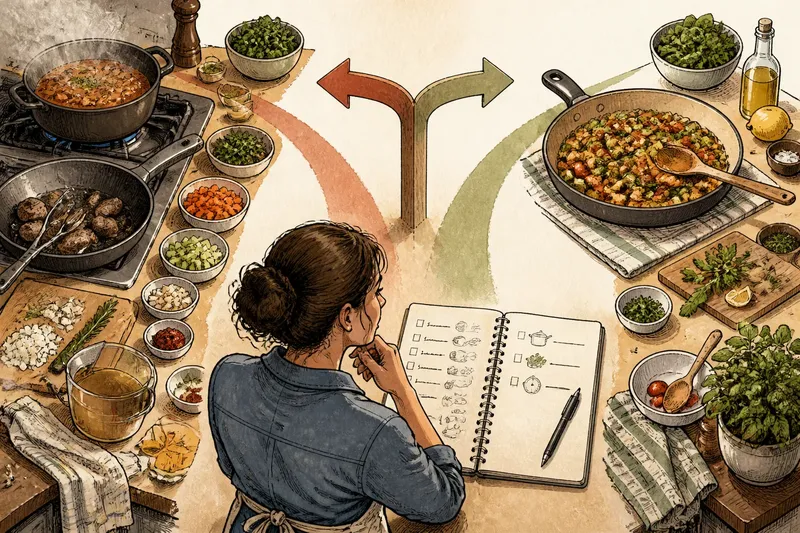
A short recipe can be careful if it makes the important decisions visible. A one-pan vegetable dish may need little more than a clear order for adding firm and tender ingredients, a cue for doneness and a final adjustment of seasoning. A longer route through separate pans might add work without improving the meal in a way the cook wants.
Short methods tend to suit cooks who need a manageable sequence, have limited workspace or prefer to adapt with what is on hand. They also make sense for dishes whose ingredients can cook together without losing their intended texture. Brevity is a strength only when it does not conceal a critical cue.
Watch for vague compression. “Cook until done” is short, but it leaves the reader guessing; “cook until the centre is tender when pierced with a knife” gives a usable signal. A concise recipe should remove needless instructions, not the information needed to make a sound decision.
How do timing and clarity change the choice?
Read the method once before starting, then notice where its actions overlap. A recipe that asks for constant attention at the same time as a separate chopping task may be difficult to follow, even if every step is sensible. A clearer sequence can help you prepare ingredients first, use waiting time well and avoid rushing the parts that need observation.
Timing is not simply a matter of minutes. Ingredients vary in size, pans hold heat differently, and ovens do not always behave alike. A robust method gives a time as a guide and adds a sensory cue where one matters. That lets you respond to the food rather than treating the clock as the only authority.
Imagine you are making a pot of lentils after work and the recipe has several separate seasoning stages. If the stages each build a distinct flavour, you might keep them and prepare the ingredients before heating the pot. If they merely repeat the same adjustment, you could combine the seasoning and check the taste near the end; the observable goal is a balanced, tender dish, not the completion of every printed motion.
Which recipe approach suits your cooking?
Choose by the outcome you care about and the conditions you have today. A detailed route is useful when technique or sequencing changes the result; a streamlined route fits when the dish is forgiving and you value fewer hand-offs. A flexible method sits between them, spelling out the important cues while leaving low-stakes choices to the cook.
- Choose a detailed method when the dish depends on distinct stages, precise order or a technique you are learning.
- Choose a short method when ingredients can cook together and the recipe still gives clear doneness and seasoning cues.
- Choose a flexible method when you want guidance on the critical moments but plan to vary herbs, vegetables or serving details.
- Pause before starting if the method relies on equipment you do not have or a time-sensitive task you cannot comfortably manage.
For packaged ingredients, appliances or specialist techniques, follow the relevant label and manufacturer instructions where they apply. For ordinary cooking choices, use the recipe’s cues as guidance and make adjustments that suit the ingredients in front of you.
What do cooks often ask about recipe length?
Does a longer recipe usually produce better flavour?
Not by itself. Additional stages can develop flavour when each has a distinct purpose, but length alone says nothing about whether those stages suit the dish or your preferred result.
Can I skip a step in a recipe?
First ask what the step changes: texture, flavour, timing or food safety. If its purpose is unclear, look for a cue elsewhere in the method; avoid skipping an instruction that addresses safe handling or cooking.
Why do some recipes include so many small instructions?
They may be written for readers who need extra guidance, or the writer may be trying to make a technique accessible. Small instructions are most useful when they prevent a likely misunderstanding, rather than repeating what the reader can already see.
How can I tell whether a short recipe is too vague?
Check whether it tells you what to prepare, what order to use and how to recognise the important changes in the food. If those cues are missing, seek a clearer method rather than assuming that brevity means simplicity.
How can you judge a recipe before you cook?
Scan for the purpose behind its stages, then check whether the sequence fits your time and tools. Look for observable cues alongside timing, and notice whether the method distinguishes essential actions from optional finishing touches. Those details tell you more than a page crowded with numbered instructions.
The recipe myth that more steps mean more care fades when you judge a method by what each step contributes. Choose the version that makes the dish’s important decisions clear, and leave room to follow the food when it gives you a better cue than the printed clock.